Executive Roundtable: Guardrails for the Autonomous Era
July 27, 2026
Ask ten engineering leaders how far their organization has actually gotten with autonomous AI, and most will admit the same thing once the marketing language drops away: not nearly as far as it looks from the outside.
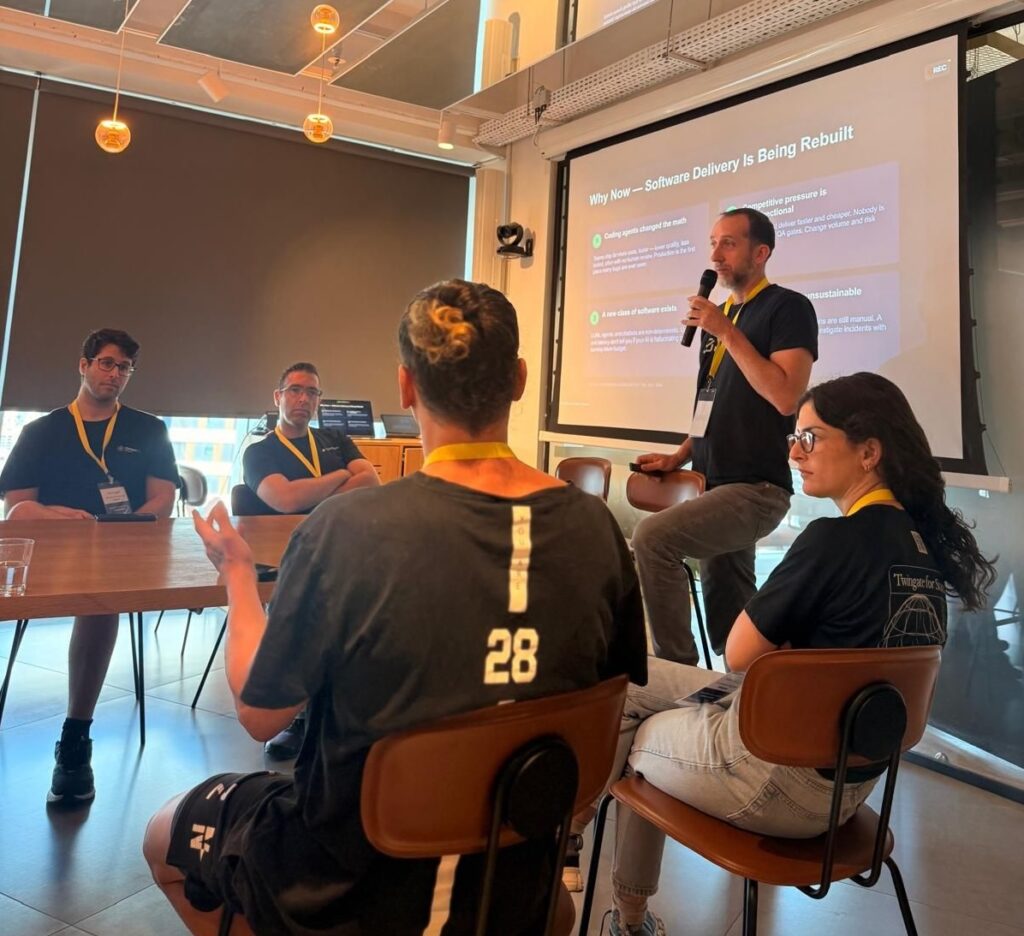
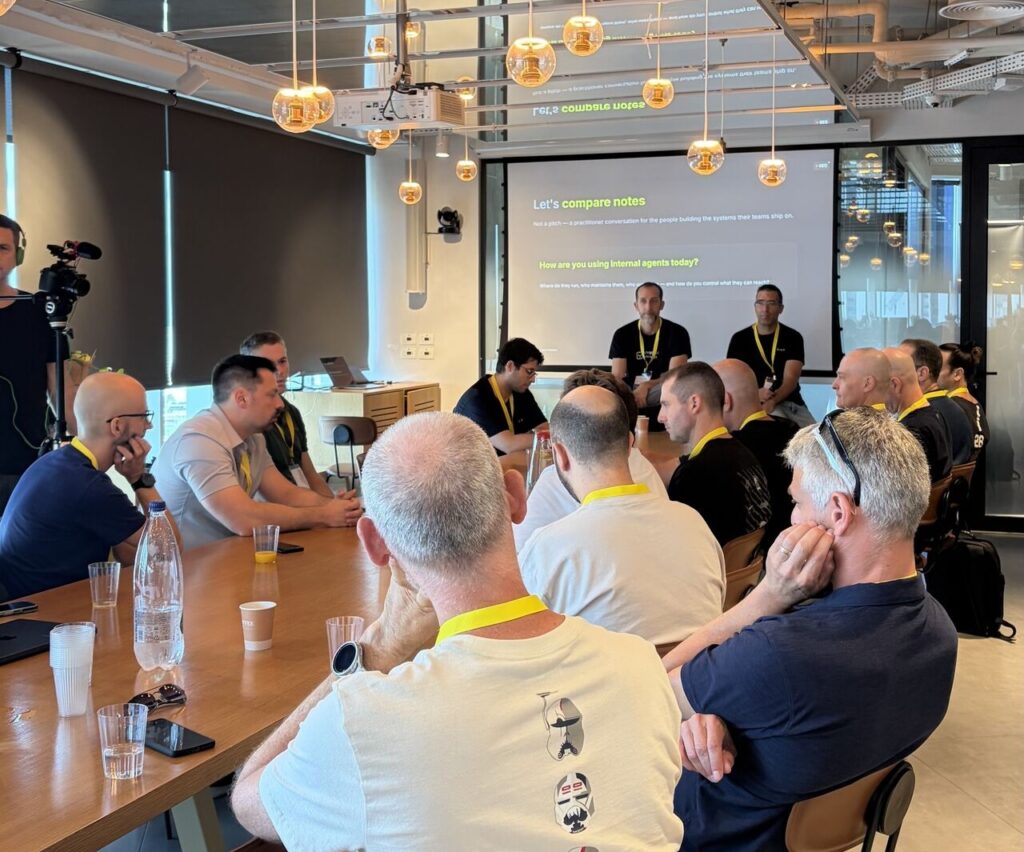
That was the undercurrent of a roundtable Logz.io and Twingate hosted on July 22, 2026, bringing together VPs of engineering, CTOs, senior security directors, and several product leaders across different industries and company stages. The topic was AI adoption across the software development lifecycle, but the real conversation was about risk. Every team in the room is already using AI to move faster. Far fewer have worked out how to do it without creating new blind spots in security, quality, or accountability.
No one claimed to have a finished playbook. What emerged instead was a working set of hard-won lessons about where the real bottlenecks are, and where they’re heading next.
The FOMO is real, and so is the reckoning
One recurring theme was the gap between what people see on social media and what’s actually happening inside most engineering teams. On LinkedIn and Twitter, every company appears fully automated, every developer is shipping ten times faster, and anyone not “going full agentic” looks like they’re falling behind. That pressure trickles down from boards to managers to individual contributors.
The reality inside the room was more grounded. Several participants described a moment, roughly six to twelve months ago, where AI coding tools felt so capable that they wondered whether engineering teams would be needed at all. Then the tools produced bad output, and the pendulum swung back toward skepticism. Since the arrival of newer coding agents, sentiment has settled somewhere in the middle. Productivity gains are real and measurable, but full autonomy is not where most companies operate today.
The path that emerged from the discussion was incremental. Pick one painful, recurring problem. Automate it fully, with a human still checking the work. Once it’s reliable, move to the next one. No one described a shortcut around this process.
Code review is splitting into camps
The liveliest part of the conversation centered on whether code review still makes sense once AI is writing most of the code.
Some teams described running fully automated pipelines with no human reading the diffs at all, relying entirely on monitoring and automated testing to catch problems after deployment. One participant described production trading systems, handling real money, built and maintained by people who don’t read code and never learned to.
Other teams pushed back hard on that model, mostly because of compliance. SOC 2 requirements around code review came up specifically, and the group worked through what “code review” actually means under that framework. Is it a human reading every line, or is it a documented mechanism for catching bugs before or after they reach production? The consensus leaned toward the second definition: a strong CI/CD pipeline, gradual rollout, and real-time monitoring can function as a review layer even without a human eyeballing every commit, and this is increasingly how auditors are willing to interpret the requirement.
The bottleneck is moving from code review toward observability
A theme that tied the event together: as AI accelerates coding, the constraint doesn’t disappear, it just relocates. Less friction at the code review stage means more pressure on what happens after code ships. Production quality, monitoring, and incident response become the new limiting factor.
One clear signal of how early the industry still is: almost no one in the room had a single production alert that triggers, gets diagnosed, and gets resolved completely without a human involved. Engineering teams often know exactly what to do when a familiar alert fires, because they’ve seen it hundreds of times, but they still do it manually every time. That specific gap, a fully autonomous response to a known, repeatable incident, was framed as one of the more achievable next steps for teams ready to go further.

A practical starting list for building this yourself
For anyone considering building their own AI-assisted observability tooling rather than buying it, the discussion produced a fairly concrete punch list.
Start with data collection. Most observability platforms already expose an MCP integration, so connecting a coding agent to your telemetry is not the hard part. The hard part is the long tail of integrations that follow: Jira, Confluence, Slack, PagerDuty or Opsgenie, and whatever ticketing or CRM system holds context that engineers rely on. Slack in particular came up as an underrated source of organizational memory, since a lot of incident context lives in threads rather than formal documentation.
Security needs early attention, not an afterthought. Sensitive telemetry, especially security-related data, often shouldn’t be visible to every engineer, and an AI agent inherits whatever access it’s given. That means access boundaries need to be designed deliberately rather than defaulted to “everything.”
Data volume is a real constraint. Observability data can run from a gigabyte a day to a hundred terabytes, and feeding that directly into an LLM with a limited context window is slow and expensive. Compression was mentioned specifically as a solution: converting repetitive log messages into patterns (the same underlying log line with a wildcard for the variable parts, rather than ten million near-duplicate entries) makes it possible to hand a week of data to an LLM without the cost or latency blowing up.
Keep a human in the loop, especially early. The suggested approach was roughly three months of human review on every automated alert before trusting the system to act independently, and even after that period, some categories of alerts should still route to a person.
Build in memory for context that isn’t obvious from the data alone. The same alert can mean “ignore it” in a dev environment and “wake everyone up” in production. Teaching that distinction to a system takes time and deliberate iteration, and there are open source libraries built specifically for managing this kind of agent memory.
Plan for governance and cost control from the start. Audit trails matter more than most teams realize, right up until there’s a security incident and they matter enormously. Cost control matters too, since an agent that gets stuck can rack up spend quickly if there isn’t a cap in place per alert or per time period.
Securing agents means rethinking identity
Twingate’s Sagie Shamay focused on a different layer of the problem: once an agent exists in production, how do you control what it can touch.
The framing was that AI agents deserve to be treated as a distinct category of identity, sitting alongside developers and end users rather than folded into either. Developers need broad access to build and maintain agents. The agents themselves need narrower, task-specific access to the systems they operate on. The people who consume an agent’s output, through a Slack message or a web interface, need a third and much narrower set of permissions.
The security shift getting the most attention is a move away from static credentials. Long-lived API keys sitting in a Kubernetes secret store are a known risk, since a leak of that key hands over standing access until someone notices and rotates it. The alternative gaining traction is ephemeral, just-in-time access built on protocols like OIDC: an agent requests access to a specific resource, states why, gets a short-lived credential if approved, and the access expires on its own. If a credential like that leaks, there’s nothing to rotate because it’s already gone.
This same logic was applied across several layers: agents accessing internal MCP servers, agents running inside Kubernetes clusters rather than on a developer’s local machine, and agents that need database or web application access. Every action should be logged and auditable, and every credential should be short-lived by default.
What people are actually doing right now
Beyond the formal presentations, participants traded real, current practices. Several teams are running coding agents like Claude Code or Cursor directly, with some experimenting with browser-based or fully cloud-hosted development environments that remove the need for a local IDE entirely. One team described a workflow where specs, low-level design, and architecture are reviewed carefully by humans up front, and once that design is locked in, implementation is handed to an agent with no further intervention until a review stage at the end.
A few honest tensions surfaced here too. One participant, working in a security-conscious environment, described being unwilling to fully trust an automated pipeline yet, despite finding the idea appealing in principle. Another raised a genuinely open question that got no clean answer: how do you develop junior engineers into senior ones when AI is doing more of the work that used to teach architectural thinking on the job.
Where this leaves things
Nobody at the roundtable claimed to have solved this. The shared takeaway was closer to a set of working principles than a playbook: start with one narrow, high-impact use case rather than trying to automate everything at once, build guardrails in from day one rather than retrofitting them, keep a human in the loop until a system has proven itself, and treat observability and security as the foundation that makes faster shipping sustainable rather than as compliance overhead bolted on afterward.
The technology is moving quickly. The operational discipline required to use it safely is what most teams are still building.
Want to learn more about how we can help your team efficiently adapt to AI observability? Let’s chat!
You Might Also Like

From Alert Noise to Automated Action: The Case for Workflow-Driven Monitoring